
The Challenge
A national retail employer, referred to here as the Employer, was named in a wage and hour class action brought under federal and state wage laws. A group of salaried employees alleged that they had been misclassified as exempt and denied overtime, claiming that most of their time was spent performing routine, non-managerial work rather than the supervisory duties their titles implied.
Cases like these rarely turn on a single fact. They turn on whether the proposed group can be treated as having a sufficiently common experience. For the defense, the question was whether the evidence showed meaningful differences in each employee’s actual job duties, schedule, responsibilities, and workplace experience.
With 152 current and former employees in the proposed group, the defense needed a practical way to identify credible, individualized context at scale and preserve it in a format counsel could review and assess. Publicly available social media and online content often contains relevant statements about job duties, work schedules, supervisory responsibilities, outside employment, compensation, and personal experiences at work.
The Plan
SMI Aware designed a matter-specific social media intelligence effort focused on the issues central to the defense.
- Subjects: All 152 current and former employees in the proposed group
- Lookback: Public online activity was reviewed back to each individual’s hire date, covering the period at issue
- Scope: Searches focused on references to the Employer, job titles and job duties, supervisory or managerial responsibilities, statements about hours, overtime, compensation, raises or bonuses, workplace conditions, and other employment or independent work that could provide relevant context
- Method: Each subject was reviewed under consistent parameters by U.S.-based analysts. Relevant public online material was securely collected and documented to support legal review and evidentiary assessment
The goal was not volume. It was relevance. The scope was designed to surface public information that could help the defense evaluate individual circumstances and avoid collecting material that did not matter to the claims.
The Results
Across the 152 subjects, SMI Aware confirmed a social media presence for 124 individuals, or 82 percent. Seventy-six subjects produced public content that fell within the defined scope.pe.
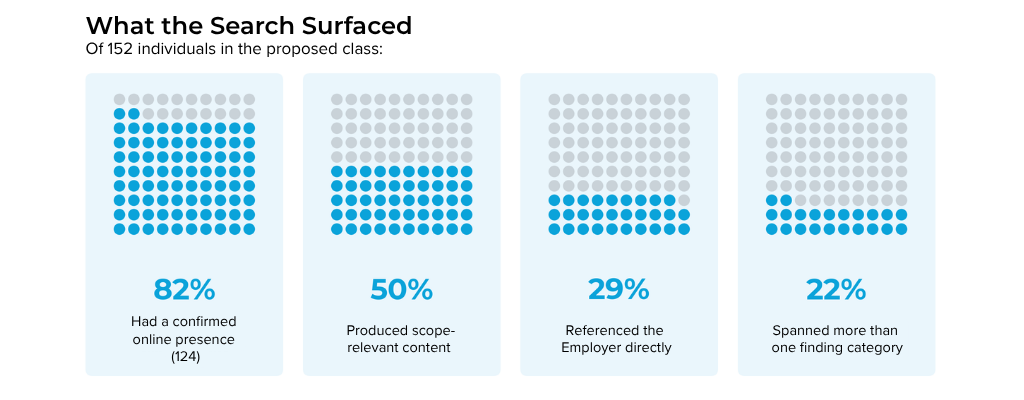
The findings reinforced the individualized nature of the proposed group. Forty-four of the 76 subjects referenced the Employer directly through posts, tags, comments, or shared content. Other findings included personal statements and public information relating to daily duties, supervisory responsibilities, working hours, compensation, and workplace conditions.
Some individuals also identified outside or overlapping employment, independent work, or other activities that gave the defense additional context for evaluating claimed work hours and individual work experiences.
That variation was the point. A case that seeks to treat many employees as one depends on a meaningful degree of uniformity. The public record showed important differences from one individual to the next.
The findings added time-stamped, person-by-person detail to a broader factual record that included affidavits, payroll records, job descriptions, and job-duty evidence. The matter was ultimately dismissed. Social media intelligence did not determine that outcome on its own, but it provided documented, matter-specific context that supported the defense’s broader position.
Why This Matters Beyond One Case
Wage and hour class and collective actions often turn on whether employees truly share a common work experience. Public social media and online content can help identify individualized facts that may not be apparent from pleadings or generalized allegations alone.
This work is not a substitute for formal discovery, witness testimony, or employment records. It gives counsel an additional factual resource to identify areas for follow-up, test assumptions, and better understand the individual circumstances behind group-wide claims.
The same approach can support a range of workplace matters, including misclassification claims, off-the-clock disputes, FMLA and leave-related claims, workplace investigations, and credibility questions in single-plaintiff cases.
How SMI Aware Can Help
SMI Aware has supported Labor and Employment matters nationwide since 2011. Our work combines experienced U.S.-based analysts, secure technology, and a documented collection process designed for matters where findings may be reviewed, challenged, or used in litigation.
We provide:
- Custom scopes aligned to the matter, the legal issues, and applicable compliance considerations
- Consistent, analyst-led review across one subject or several hundred
- Secure documentation and preservation structured to support legal, HR, and evidentiary review
- Relevant findings that help counsel focus on the facts that matter without unnecessary noise
For wage and hour disputes, misclassification claims, and other workplace matters, SMI Aware helps legal teams develop a clearer, more individualized understanding of the public record.
Contact SMI Aware to discuss your matter.
support@smiaware.com | 888.299.9921